
WASHINGTON (AP) — A U.S. government watchdog released its first report Monday on the impact of the Iran war, acknowledging the military’s advanced weapons shortfalls and offering the first public look at the damage to American aircraft, bases and diplomatic outposts in the Middle East.
Much of the information has been previously reported over the past six months, but the Pentagon inspector general’s report offered the fullest official accounting so far of the conflict’s costs in American lives, taxpayer dollars and physical damage. It included information from the watchdogs for the Defense and State departments as well as the U.S. Agency for International Development.
The report, whose publication was first reported by NBC News, noted that the U.S. war with Iran “has resulted in strategic inventory shortfalls and revealed industrial base bottlenecks for munitions resupply” in regard to advanced weapons. Experts have previously said it will take about three years for military contractors to replenish advanced missiles and defensive missile interceptors to prewar levels.
The Pentagon has repeatedly pushed back against reports of any munitions shortage, saying the U.S. military has all the weapons it needs to fight any conflict. President Donald Trump said in a social media post Monday that the U.S. is “producing more Exquisite and Elite Weapons than at any time in our History.”
“They are being delivered on a daily basis to our Forces in the Middle East, and beyond,” he wrote.
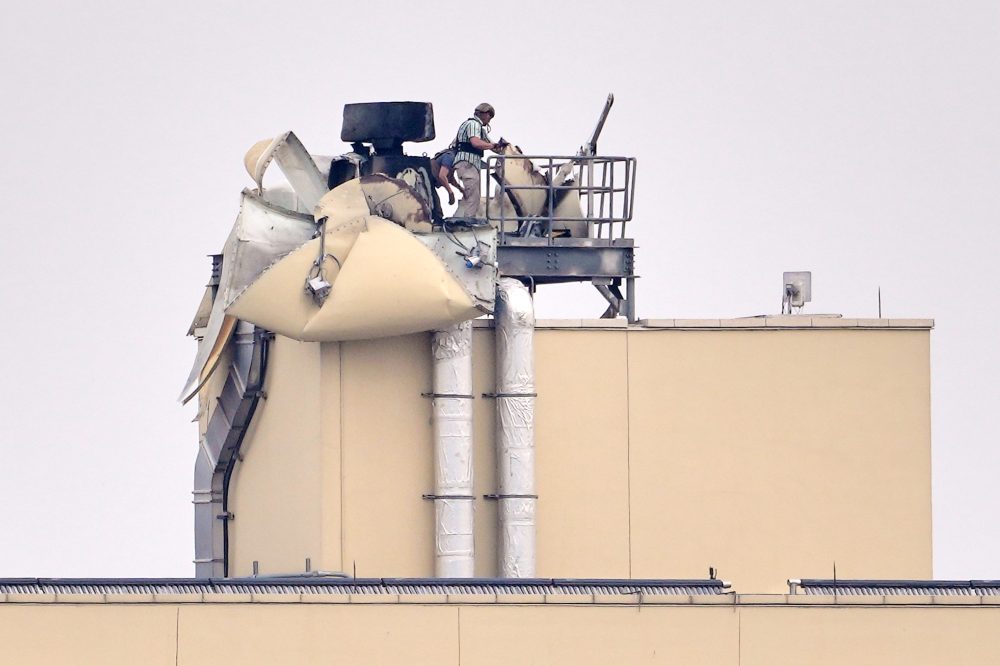
The watchdog report, which covers April 1 to June 30, also acknowledged that Iranian strikes damaged and destroyed hundreds of buildings and other structures at U.S. bases in Kuwait, Bahrain, Qatar, the United Arab Emirates, Saudi Arabia, Iraq, Oman and Jordan.
It noted that the U.S. naval base in Bahrain, a Navy logistics hub in the region, was targeted with Iranian drones and ballistic missiles. U.S. Central Command had to shift to supply lines to alternate hubs that were much farther away, including Diego Garcia, a U.S.-U.K. base on an island in the Indian Ocean. It required “14- to 18-day logistics cycles” to support operations in the Middle East, the report said.
Acting Navy Secretary Hung Cao acknowledged in an interview with The Epoch Times last week that “they blew the hell out of Bahrain” and said he has a task force looking into whether the Navy would need to repair the base in Bahrain to sustain its forces in the region.
Dozens of American aircraft and drones also were destroyed or damaged by Iran, including the destruction of as many as 30 MQ-9 Reaper drones that cost around $30 million apiece, the report said. Seven KC-135 refueling aircraft were damaged or destroyed, including five that were struck by Iranian munitions while on the ground in Saudi Arabia.
Another KC-135 crashed in Iraq, killing six service members, following a collision with another KC-135. Those deaths, and the death of a pilot of a helicopter that crashed into the Arabian Sea, are listed as occurring during non-hostile events. Eleven other service members are listed as “killed in action” in Kuwait, Iraq, Jordan and Saudi Arabia.
Defense Secretary Pete Hegseth told Congress in late July that the war had cost $37.5 billion so far.
The costs in physical damage to U.S. diplomatic facilities, however, had not been previously publicly released. Such outposts in Iraq, Kuwait, Saudi Arabia and the UAE were damaged by Iranian strikes, with an estimated cost of $184 million, according to the report.
The State Department reported in early June that its other costs from the conflict came to $113 million, with nearly $80 million used to respond to contingency plans, including evacuation expenses for U.S. personnel and their families as well as other American citizens and eligible third-country nationals.
The State Department reported that in the weeks and months after the U.S. and Israel first struck Iran on Feb. 28, the Trump administration evacuated about 9,000 U.S. citizens from countries in the Middle East and Europe. Through private and commercial flights as well as land and water travel, the cost of the department’s evacuation operation was more than $11 million as of late June.
“State determined that consular officers would not be able to fully document travel itineraries required to seek reimbursement from evacuees and therefore it would be impracticable to seek reimbursement from them,” the report states.
The majority of the evacuations were made from Israel, with Iraq and Jordan following shortly behind. While the U.S. only evacuated 1,200 Americans from the United Arab Emirates, those trips to Istanbul, Athens and Washington cost the most, at more than $4 million.
The State Department reported that more than $44 billion in emergency and non-emergency military sales also were made in that span of time, with the majority of sales going to Saudi Arabia. Sales included military helicopters, munitions and munitions support as well as advanced precision weapons system.
Other regional countries, including Qatar, Kuwait, UAE and Israel, also received billions in sales, as Iran retaliated against nearly every country in the region that hosted a U.S. military base.
___
Amiri reported from New York.
Brought to you by www.srnnews.com