
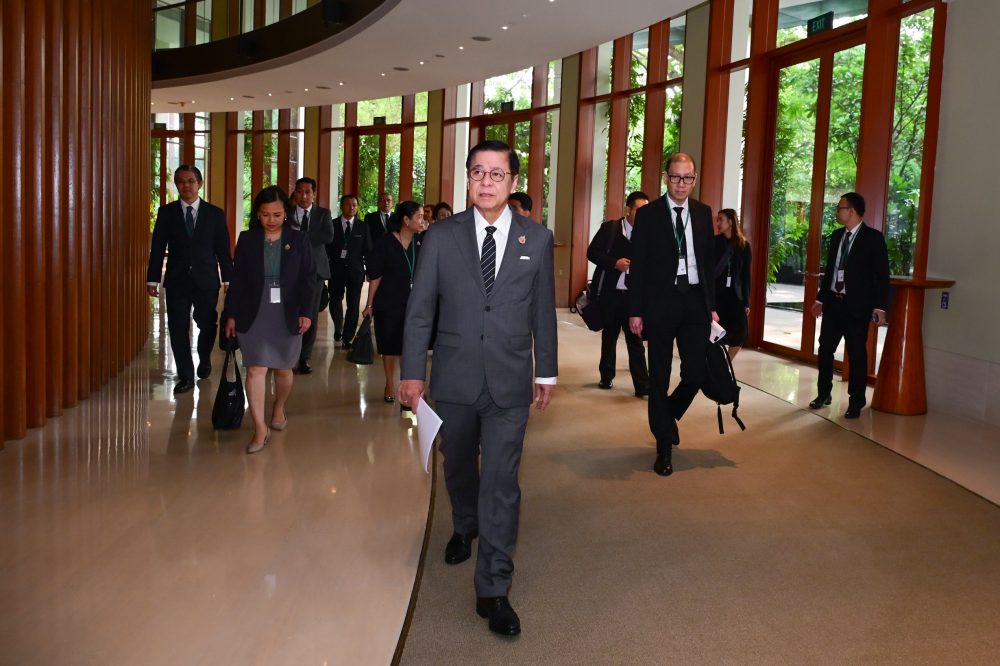
BANGKOK (AP) — Thailand and Cambodia’s foreign ministers exchanged opening statements in Singapore on Tuesday at the first meeting to settle a sea border dispute under a U.N. agreement on maritime law for compulsory conciliation.
At issue is territory claimed by both that is believed to contain large, exploitable amounts of natural gas and other hydrocarbons.
The decision to take the matter to the U.N. Convention on the Law of the Sea, or UNCLOS, was triggered by Cambodia in June after Thailand terminated a 25-year-old memorandum of understanding meant to resolve overlapping maritime claims.
Thailand’s decision to revoke the agreement came unilaterally after a sharp deterioration in relations and armed combat with Cambodia last year. The Southeast Asian neighbors fought over competing claims to territory along the land border in July and December. Several dozen civilians and soldiers on both sides were killed and hundreds of thousands of people displaced.
Thai Foreign Minister Sihasak Phuangketkeow and his Cambodian counterpart Prak Sokhonn led their delegations in the first conciliation meeting with the five-member UNCLOS commission, held in Singapore from Monday to Wednesday.
Cambodia called for a peaceful resolution, which “serves the peoples of both nations and contributes to peace, cooperation and shared prosperity in the region,” Prak Sokhonn said in his statement Tuesday.
He said Cambodia was compelled to consider other peaceful options and chose to initiate the UNCLOS proceedings “in keeping with its commitment to the rule of law and to the peaceful settlement of disputes.”
Sihasak said Thailand has been unwavering in its commitment to uphold international law and peaceful settlement in disputes. He argued that the revoked agreement “had produced no concrete progress,” as the two countries managed to hold only two meetings over a period of 25 years.
He said Thailand wished to “give negotiations a fresh start,” and that it had offered Cambodia an opportunity to hold direct talks, which Cambodia disregarded, before moving on to the UNCLOS conciliation process.
“Thailand stands ready to engage in this process constructively, with the aim of achieving, with the Commission’s assistance, a negotiated and equitable solution,” the Thai foreign minister said.
A fragile ceasefire between the two countries was agreed in late December, but tensions continue with sporadic incidents and large-scale deployment of military forces.
Any UNCLOS ruling isn’t binding on the parties involved, even though both countries are signatories to the international pact.
Thailand has been averse to having territorial issues decided by third parties rather than handled bilaterally. It has long felt a 1962 ruling by the International Court of Justice awarding Cambodia the hilltop Preah Vihear temple along their border to be unfair, contributing to ongoing tensions between the neighbors.
—
Sopheng Cheang reported from Phnom Penh, Cambodia.
Brought to you by www.srnnews.com