
By Iain Withers and Wayne Cole
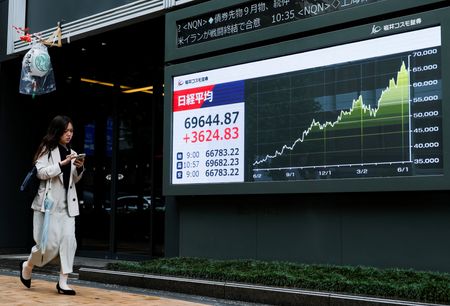
LONDON/SYDNEY, Nov 26 (Reuters) – Stock markets in Europe and Asia posted solid gains on Thursday as the latest salvo of US tariffs looked less damaging than first feared, while the Thanksgiving holiday offered a welcome break from AI jitters.
White House proposals for new tariffs on 14 major trading partners including China, Japan and the European Union sprang no nasty surprise and, crucially, will not stack on top of those imposed in July. The new rates are also unlikely to be imposed until February or March.
“The macro impact from this increase is likely to be modest, particularly given the fact that the investigations have been telegraphed well in advance,” said analysts at JPMorgan.
“Several key imports are still exempt from tariffs, including tech goods, and the administration has shown itself to be sensitive to market disruptions,” they added. “This sensitivity should limit the severity of tariff increases going forward.”
Stocks in Europe gained 1.6% in early trading, following on from gains across Asia, pushing the broad MSCI global index up 0.4%.
Wall Street is closed on Thursday for the Thanksgiving holiday, but futures are trading. S&P 500 futures and Nasdaq futures rallied around 0.5% apiece, having come back from sharp early losses during the previous session.
China said on Thursday it reserves the right to take necessary measures in response to the latest US tariffs.
FEAR OVER AI TRADE ‘PALPABLE’
“I think the market, barring very extreme numbers, will discount some of this (tariffs) news really,” said Tristan Hanson, multi-asset fund manager at M&G, adding that the rally had taken its cue from US markets steadying overnight, although concerns about the AI trade and vast spending on infrastructure to build out the technology remained.
“In recent days, the fear level has been quite palpable,” he said.
Tech giant Nvidia remained a source of unease after S&P put its credit rating on watch for a possible downgrade, citing weaknesses in the chipmaker’s management and board.
Nvidia stock ended down 3.9% at $149.30 on Wednesday, a staggering $2.3 trillion short of its October peak of $243.37.
Elsewhere in tech, Elon Musk said overnight that every child in the US will receive two shares in SpaceX, the space and AI company he runs, pledging a gift worth some $18 billion.
US FED DECISION IN FOCUS
Bond investors are wondering if the broad losses in global stocks this month coupled with doubts about the durability of AI-driven business investment might temper the hawkishness of central banks.
While futures imply a 98% chance the Fed will raise rates by 25 basis points in December, speculation of a half-point increase has faded.
Still, the prospect of extra tariffs was not exactly helpful to the outlook for inflation.
“The additional tariff burden is likely to be small, but will still provide a marginal boost to prices and keep core goods inflation firm into next year,” said Stephen Brown, chief North America economist at Capital Economics.
In currency markets, the dollar index was broadly flat at 103.71.
The euro steadied at $1.0973 from its recent low of $1.0881, while the dollar flatlined on the yen at 159.17, with the risk of intervention keeping 160.00 resistance intact.
The Bank of Japan must respond swiftly to signs of an inflation overshoot, including by accelerating the pace of interest rate hikes, hawkish board member Naoki Tamura said on Thursday, keeping alive prospects of a rate increase as soon as December.
In commodity markets, oil prices held firm after Yemen’s Houthis said they had attacked Saudi Arabia’s largest oil refinery, raising concerns about unexpected Middle East supply disruptions. [O/R]
Brent futures rose 0.9% to $93.8 a barrel, while US crude futures added 0.2% to $83.32 a barrel.
Gold dipped 0.2% to $3,572 an ounce, having fallen nearly 8% so far this month to hit one-year lows. [GOL/]
(Reporting by Wayne Cole and Iain Withers; Editing by Kate Mayberry, Saad Sayeed and Conor Humphries)
Brought to you by www.srnnews.com